DISCLAIMER:
This website is for educational or entertainment purposes only.
It describes published historical practices and my reckless attempts to replicate them.
Some of the species used have TOXIC, POISONOUS, & DEADLY properties.
Other practices recorded are inherently DANGEROUS & potentially FATAL.
To be safe, DO NOT try anything on this website!
!!!!!!!!!!!!!!!!!!!!!!
NOTE: THIS WEBSITE IS STILL UNDER CONSTRUCTION.
Many hundreds of species accounts I have written are being gradually added.
For those concerned with my use of the term “American Indian” or use of past tense regarding their ethnobiology, please see my page here.
ABOUT PALEO FORAGING:
Why I created this:
I could never find a satisfactory foraging guide. No foraging book (I have over 30), website, or other media had satisfactory accounts of usable species. Most had rather few species and relied heavily on repeating uses of extremely common introduced species found in yards. Very few guides back up any of their claims. The species listed often did not seem very practical. (A dandelion is edible, sure, but doesn’t taste great and could never be considered a valuable food resource.) And preparation methods were often lacking.
Historical accounts of American Indian ethnobotany were the first answer for me. They were actually foragers, the ultimate experts. So, I compiled every reference describing how Indigenous peoples living in foraging societies in North America historically used their environment.
How I got information:
I have gone through hundreds of thousands of pages of American Indian ethnobotanies & ethnographies (mostly from 1890 to 1940), early American histories (from 1528 to 1900), and archaeological studies. I have used primary sources whenever practical. And I back up every fact I assert with a reference and page number.
So far, I have checked over 100 ethnobotanies, over 1000 ethnographies, over 600 early histories, and dozens of archaeological studies.
See the “references” tab for many of my sources.
What I’ve found:
I have recorded uses of over 1000 plant species in Texas alone. Many of the uses have never been published outside of old, obscure, or difficult-to-find sources.
I have recorded the uses of about 500 insect species for food.
I focus on plants, especially edible ones in Texas, with a secondary focus on edible insects. But I will include everything, such as minerals and vertebrates, eventually.
I am continually attempting to personally replicate as many uses as possible, starting with local species. I am gradually filming and editing videos of my foraging practices and summaries of my research, which I upload here: Paleo Foraging – YouTube.
I have accounts on Instagram, Facebook, and TikTok, to which I regularly post short videos as @paleoforaging.
I am editing a manuscript of my research, which I plan to publish in the near future, allowing the public access to most everything I know about Texas ethnobotany.
For now, you can access my foraging book, “Native Food Plants of Texas,” here for the paperback, or here for the E-book.
About me:
I am a naturalist, foraging instructor, ethnobiology researcher, and Paleolithic technology expert, with a decade or more of experience in all these. I have taught courses and been employed as a researcher at UT Austin and UC Berkeley, my alma maters. I was named a National Geographic Young Explorer and a National Science Foundation Graduate Research Fellow.
I founded Paleo Foraging in 2023, dedicated to preserving and sharing knowledge of the uses of wild species, especially based on traditional Indigenous practices. I am a lifelong forager and outdoorsman. I am from Austin, Texas, where I continue to live and teach.
I love to camp, hike, travel, exercise, draw, play music, and read. I am the author of “Native Food Plants of Texas: an Austin Forager’s Guide Based on Indigenous Knowledge” (2025).
– Cyrus Harp

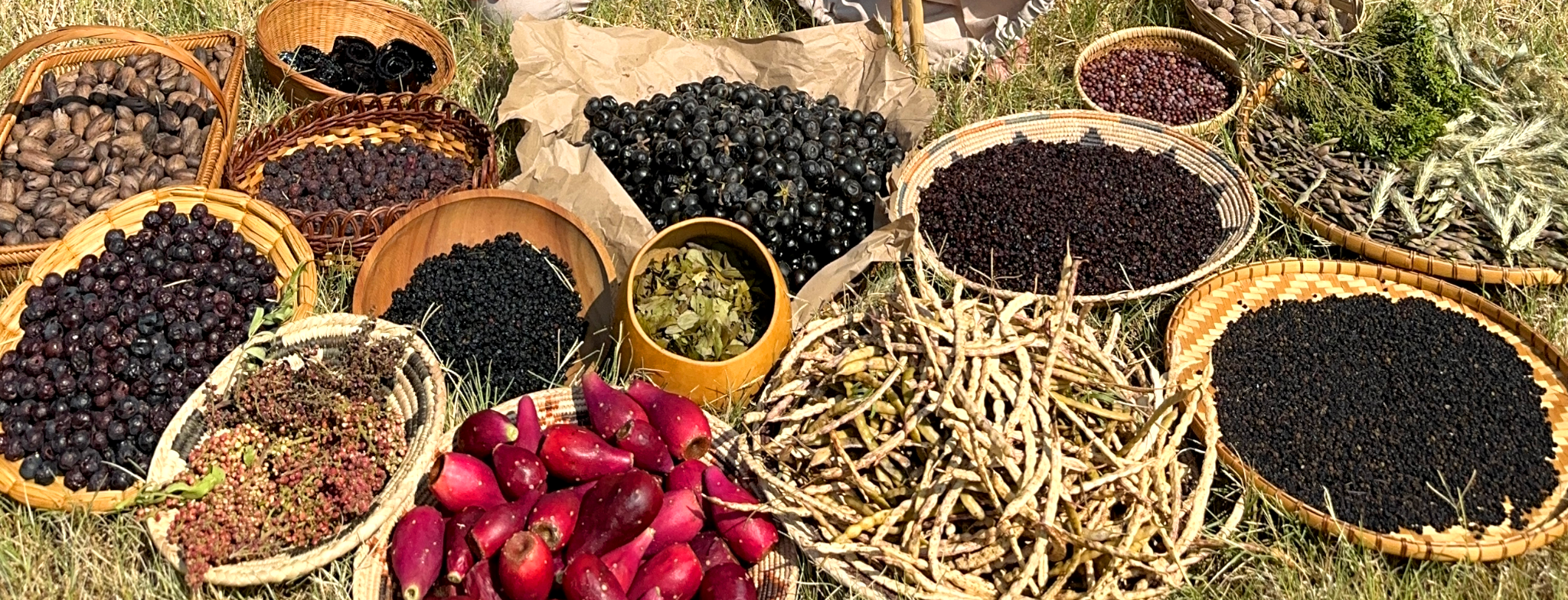
A day’s foraging haul in midsummer 2025, Austin, TX.


Paleo Foraging LLC
5900 Balcones Drive Suite 100
Austin, TX 78731